
Back office resilience, 4 min read
The $25,000 Resignation Letter
When a key back-office employee leaves, the expensive part isn't hiring their replacement. It's everything that happens after their last day and before you fill the vacancy.
It usually arrives on an ordinary Tuesday. Your bookkeeper, the one who runs payroll, pays the vendors, and somehow knows why the March bank reconciliation never quite ties out, hands you a letter. Two weeks' notice. They've found something closer to home, or with better hours, or they're simply ready for a change.
Most business owners and executive directors see turnover as a hiring cost: a job posting, a few interviews, maybe a recruiter's fee. That's real, but it's the smallest piece. The higher cost is the void, the weeks or months between the day that letter lands and the day a new person is genuinely up to speed. In a small organization where one or two people carry the entire back office, that void can easily cost $25,000 or more.
The void nobody budgets for
Payroll still has to run every pay period. Vendors still expect payment, and customers or funders still need to be invoiced. Month-end still has to close, and payroll taxes still have to be deposited on time.
Someone has to do that work, and in most small organizations that someone is the owner, the executive director, or another manager who already has a full-time job. The salary you're no longer paying doesn't offset much, because the work didn't disappear. It just moved to the most expensive person in the building, or it didn't get done at all.
Calculating the cost
Recruiting covers job postings plus roughly 30 hours of screening, interviewing, onboarding, and recruiter fees (if used). Cleanup is outside help to clear the backlog and fix errors made during the gap, or a higher bill next Spring when the tax preparer takes more time to file the return. Ramp-up is three months at roughly half productivity.
The largest slice deserves a closer look. If diverted leadership attention consumes ~8 hrs per week for 3 months, what is the real cost of this lost time? Eight hours a week is a full day the owner or executive director isn't spending on sales, fundraising, managing staff, or planning. Those are the hours that grow an organization, and they're the hardest to get back. The proposal that didn't get written or the donor who didn't get a call won't show up on any invoice, but it's often the most expensive part of the void.
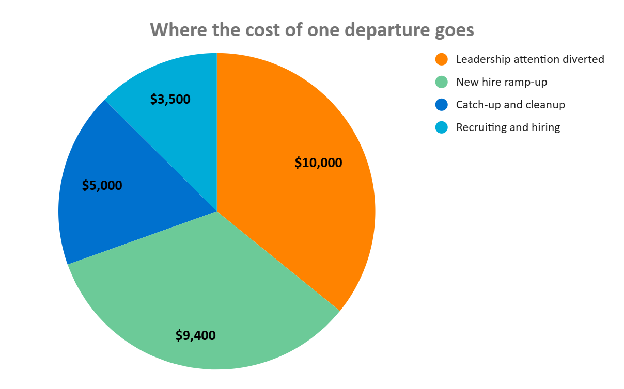
That total doesn't include the costs that are harder to put a number on: a late payroll tax deposit and the IRS penalties that follow, missed early-payment discounts, invoices that go out weeks late and slow down your cash, or a grant report filed with numbers nobody can fully explain. Any one of those can push the real cost well past $25,000.
If it takes more than three months to fill the vacancy, these costs only go up.
What walks out the door
The dollars are only part of it. When one person carries the back office, they also carry knowledge that was never written down: which vendor needs a paper check, how the benefits deductions are set up, why one account is coded the way it is, where the login for the state unemployment portal lives.
That knowledge leaves with them. The new hire spends their first months rediscovering it, often by making the same mistakes the last person learned to avoid. Meanwhile, decisions that depend on current financials sit on hold because nobody trusts the numbers.
Five ways to protect your organization
You can't prevent every resignation, but you can make sure one doesn't derail you.
- Document the routine. Keep a simple procedures guide for payroll, bill pay, invoicing, and month-end close. It doesn't need to be polished; it needs to exist.
- Keep a secure list of systems and logins. Store access to bank, payroll, tax, and software accounts in a password manager that more than one trusted person can access.
- Cross-train someone. Even if they never do the work day to day, a second person should know how payroll runs and where things stand.
- Separate key duties. The person who pays the bills shouldn't be the only one who reconciles the bank account. This protects you from errors and from fraud, not just from turnover.
- Line up backup before you need it. Know who you would call the day a resignation letter lands, so the work keeps moving while you hire.
How FFI helps
Forward Financial Intelligence works alongside small businesses and nonprofits in Charlottesville and Richmond whose accounting and HR functions rest on one or two people. We add the expertise a small team may not have, from multi-state payroll to audit preparation, and because we already know your books and your processes, we're ready to step in and scale up the day turnover happens.
That means payroll still runs, vendors still get paid, and your month-end still closes while you take the time to hire the right person. When they start, we help them get up to speed instead of starting from scratch.
Find out what a resignation letter would cost you. Schedule a free Back Office Continuity Assessment at fwdfi.com/continuityconnect, email hello@fwdfi.com, or call 434.214.0772. We'll look at where your back office depends on a single person and what it would take to protect it.
Newsletter sign-up is coming soon
One short email a month with the latest answers. Until then, this page is the best place to find them.